After completing their learning on Trauma-Informed Education, the participants of the second cohort created capstone projects that they have shared with the community. After viewing the inaugural materials, course participants were asked to select one principle or insight from their learning journey and consider how they may apply it to their specific context. Each capstone includes a video from the participants and supporting documentation that you may explore.
Designing Early Course Safety in a Reflective Learning Environment
Anzar Khaliq
“This capstone project is situated in an undergraduate first-year general education course focused on life design, identity exploration, and reflective learning. The course invites students to examine their values, assumptions, and aspirations through structured reflection, dialogue, and design thinking practices. Students typically enter the course as relative strangers, yet are expected to engage in self directed meaning-making early in the semester. As a result, the opening weeks play a significant role in shaping whether the classroom develops into a space for thoughtful engagement or remains a site of guarded participation.”
Finding Me in Music: A Trauma Informed Course for Empowering Educators
Barbara Nussbaum Stellenbosch, South Africa
“In this capstone project, Finding Me in Music (TIA). I aim to develop a course, which uses a trauma informed music-centric approach. to support educators. My intention is to empower teachers to shift from merely surviving the emotional demands of the classroom to cultivating a grounded, self-led way of being. This project will produce and pilot-test a short course supported by reflective workbooks and peer-based learning.”
Building Trust in Student-Staff Partnerships Through “Realise,” Compassion & Curiosity
Esai Reddy
“The trauma-informed principle Realise asks educators to recognise the widespread impact of trauma and understand that trauma shapes how individuals engage in learning, collaboration, and institutional life. In the context of student–staff partnerships, “realise” reminds us that both students and staff bring lived experiences—historical, socio-economic, personal, and institutional—that influence trust, communication, and participation.”
The Compassion Dividend: Trauma-Informed Excellence in Higher Education
Hind Lebdaoui Ifrane, Morocco
“As an associate professor of finance and holistic adviser at Al Akhawayn University (AUI), I connect deeply to the principle [of safety] through my shift from “tough” grading to empathetic support, like personalized feedback that makes students feel “seen.” In our high-pressure university setting, where mental health challenges are rising amid economic uncertainty, implementing safety addresses retention gaps: our pilot holistic advising showed improved well-being, grades, and engagement, proving compassion yields measurable ROI over costly recruitment.”
Collaboration and Mutuality: A Teacher’s Guide to Building Partnership with Students
Jackson Buzingo Kasulu, Tanzania
“In Tanzanian context, the traditional view of a teacher is often one of absolute authority the “expert” standing at the front, while the student is the passive receiver. However, the principle of Collaboration and Mutuality challenges us to shift this dynamic. It emphasizes that true healing and learning happen through meaningful relationships and shared power which is contrary to the reality of Tanzania’s classrooms.”
Creating a Safe Classroom Through Trauma Informed Approach
Kamal Chowdhury Bangladesh
““Safety”, one of the key principles of Trauma Informed Approach will be topic of my Capstone project. I found myself to be more drawn towards it than other principles of TIA, felt a personal connection as I too experienced the lack of safety in a classroom environment impacting on my engagement with learning and personal growth and how it also changed my motivation to learn when safety is ensured in a learning environment.”
“I developed Education by a New Name: Love to create a potentially life transforming resource to be used as part of my dissertation work. My plan is to engage high schoolers in 12-weeks of Trauma-informed Education with the purpose of showing that cultivating spaces of healing, love, and holistic uplift and thrive, is possible; And available to educators who are willing to seek out and contribute to deep and meaningful work.”
The Crisis of Preparedness: Equipping Teachers for the Trauma-Informed Classroom
Brandy Larrance Glen Ellyn, United States
“Emotions are often viewed as irrational and unruly, associated with acting out of control. Given this, we often expect our students to leave emotions outside of the classroom, because if we make decisions without emotions, “purely rationally,” we become more sophisticated thinkers and decision-makers…As teachers, we want our kids to learn. To foster the best learning environment, we must pay attention to our students’ emotions and how they are feeling. Because learning cannot take place in the absence of emotion.”
“This project focuses on the trauma-informed principle of transparency and empowerment through the framework of the survival brain versus learning brain being introduced in the classroom. A modification to this framework is presenting it as a spectrum on a scale of 1 – 10, rather than two binary categories. This eliminates any pressure, and risk in binary thinking, allowing a more accurate identification of the student’s current state. By providing space to acknowledge the middle ground, students are able to communicate their exact needs without the pressure that they must categorise their neurological state as one of the binaries. This reframing not only provides students with self-advocacy opportunities, but also allows educators to adapt their approach and be responsive to the needs of the student’s current neurological capacity.”
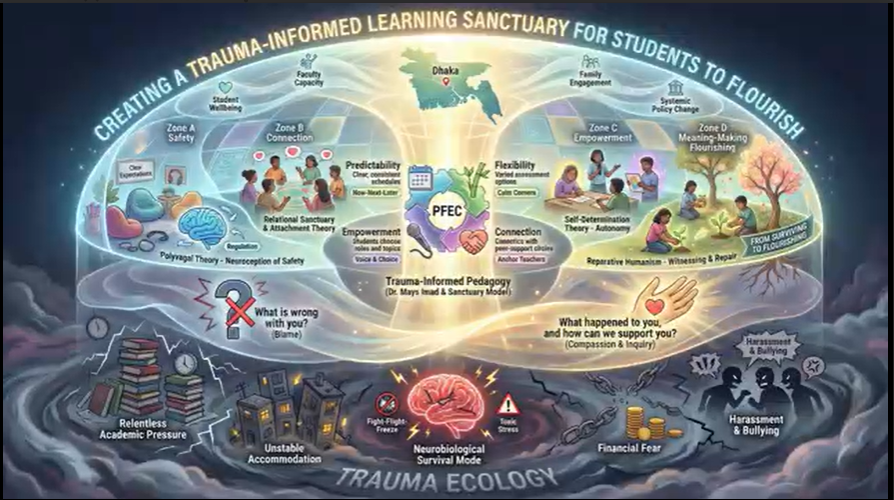
Creating a Trauma-Informed Learning Sanctuary for Students to Flourish
Mahjabeen Haque Dhaka, Bangladesh
“University students in Bangladesh increasingly face chronic stress stemming from academic pressure, financial insecurity, unstable living conditions, political clashes, and social uncertainty. This trauma ecology often places students in prolonged neurobiological survival states that impair attention, memory, emotional regulation, and learning. Contemporary neuroscience affirms that learning cannot occur without emotional and physiological safety. Alongside global trauma-informed practice, Bengal’s spiritual heritage offers a powerful ethical grounding. Lalon Shah’s “Sab Loke Koy Lalon Ki Jat” (meaning People ask about caste, but the soul has no label) challenges labeling and exclusion, affirming the inherent dignity of the human soul beyond caste, status, or identity. Grounded in Dr. Mays Imad’s trauma-informed pedagogy and resonant with Lalon’s humanist vision, this initiative proposes a Trauma-Informed Learning Sanctuary to restore safety, belonging, and the conditions necessary for students to flourish academically and spiritually.”
Fostering Resilience and Empowerment Through Trauma-Informed Education
Dr. Sekagya Yahaya Hills Kagali Kampala, Uganda
“The principle of ‘Fostering Resilience and Empowerment through Trauma-Informed Education’ is important in trauma-informed practices because it turns the hitches into empowerment for meaningful engagement as catalyst for societal transformation. In my practice as a traditional spiritual healer and an advocate to traditional medicine practice, I have appreciated that numerous skilled traditional healers constantly suffer historical social injustice through marginalization, misrepresentation and suppression of their spiritual identity and practices, done by community, religious and political leaders, and the Ministry of Health. The enacted the “Traditional and Complementary Medicine Act 2019” has not benefited healers, since it has not been operationalized even after 6 years. The traditional healers should acquire confidence, work together and engage their community leaders and the Ministry of Health to defend their rights and roles.”
Culturally Responsive Trauma-Informed Healing in African Contexts
Sekagya Yahaya
“This capstone project proposes an integrative model that centres African worldviews of trauma while aligning them with contemporary trauma-informed principles such as safety, empowerment, trustworthiness, collaboration, and cultural humility. The project positions traditional healing not as an alternative to mental health care, but as a complementary system with evidence-informed practices that warrant serious scholarly and clinical consideration.”
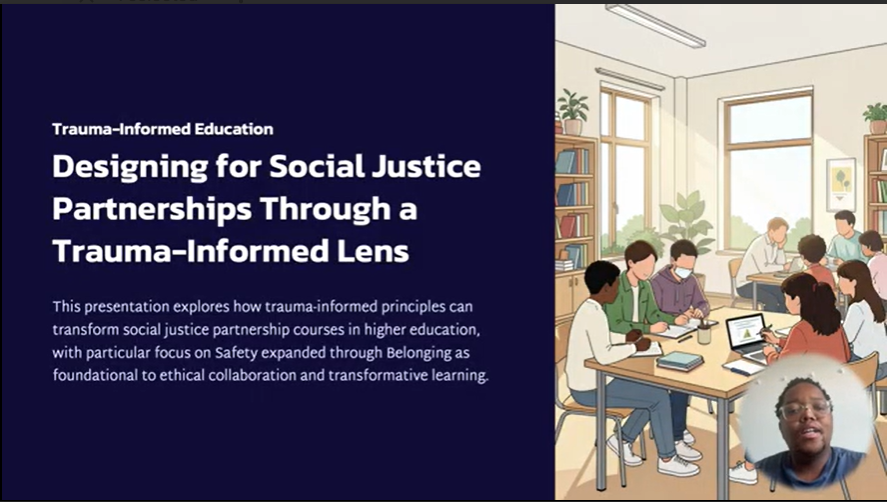
Safety and Belonging in Designing for Social Justice Partnerships Short Course
Tefo Mosienyane Cape Town, South Africa
“The trauma-informed principle selected for this application is Safety, expanded through the closely related concept of Belonging. Within trauma-informed practice, safety extends beyond physical protection to include emotional, relational, and psychological dimensions, ensuring that individuals feel secure enough to participate, take risks, and engage authentically. Belonging strengthens this principle by emphasising inclusion, dignity, and the right to participate without having to prove worth or resilience. Together, safety and belonging form the foundation of trauma-informed approaches, as learning and collaboration are significantly shaped by individuals’ prior experiences of harm, marginalisation, and institutional trust.”